On this pageShow contentsHide contents
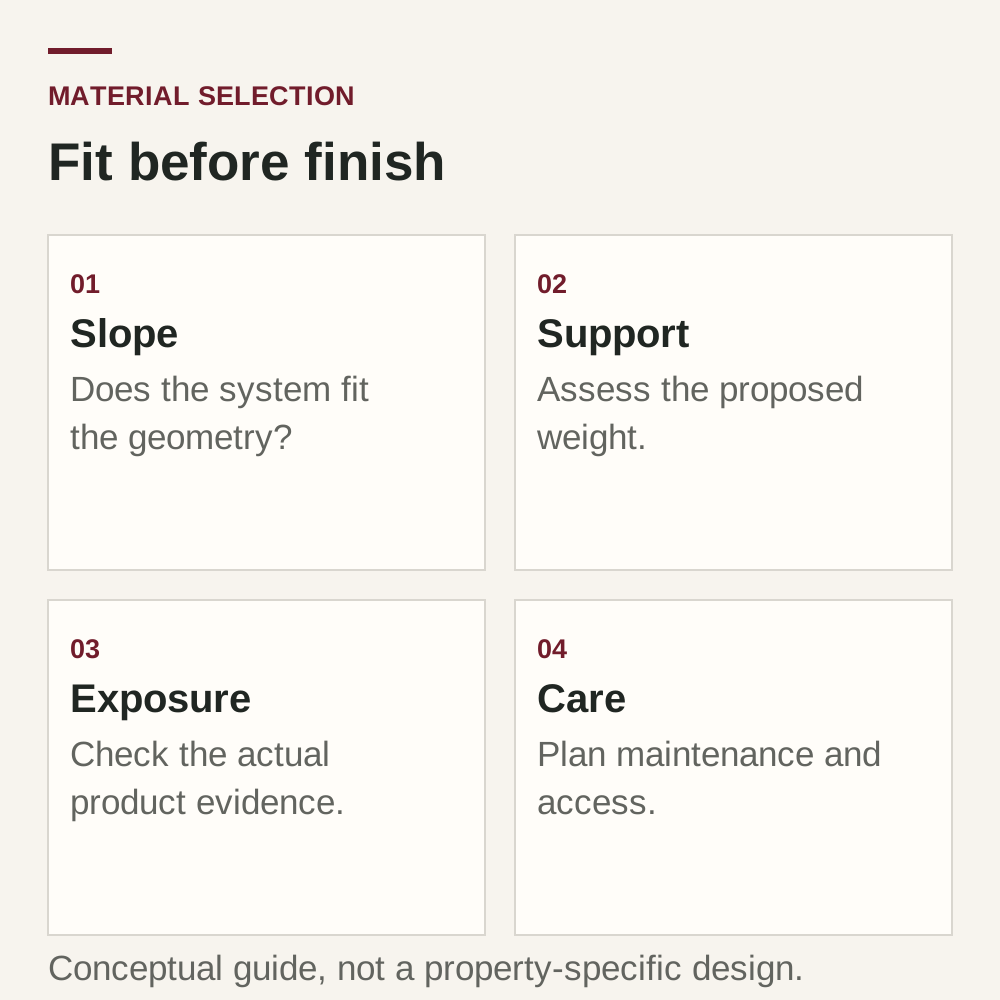
Start with the roof you have, not a favorite material. Slope, structural support, water-management details and the condition of the existing layers can rule options in or out before color enters the discussion. The covering is one part of a system; workmanship and maintenance still matter.[1]
Asphalt shingles
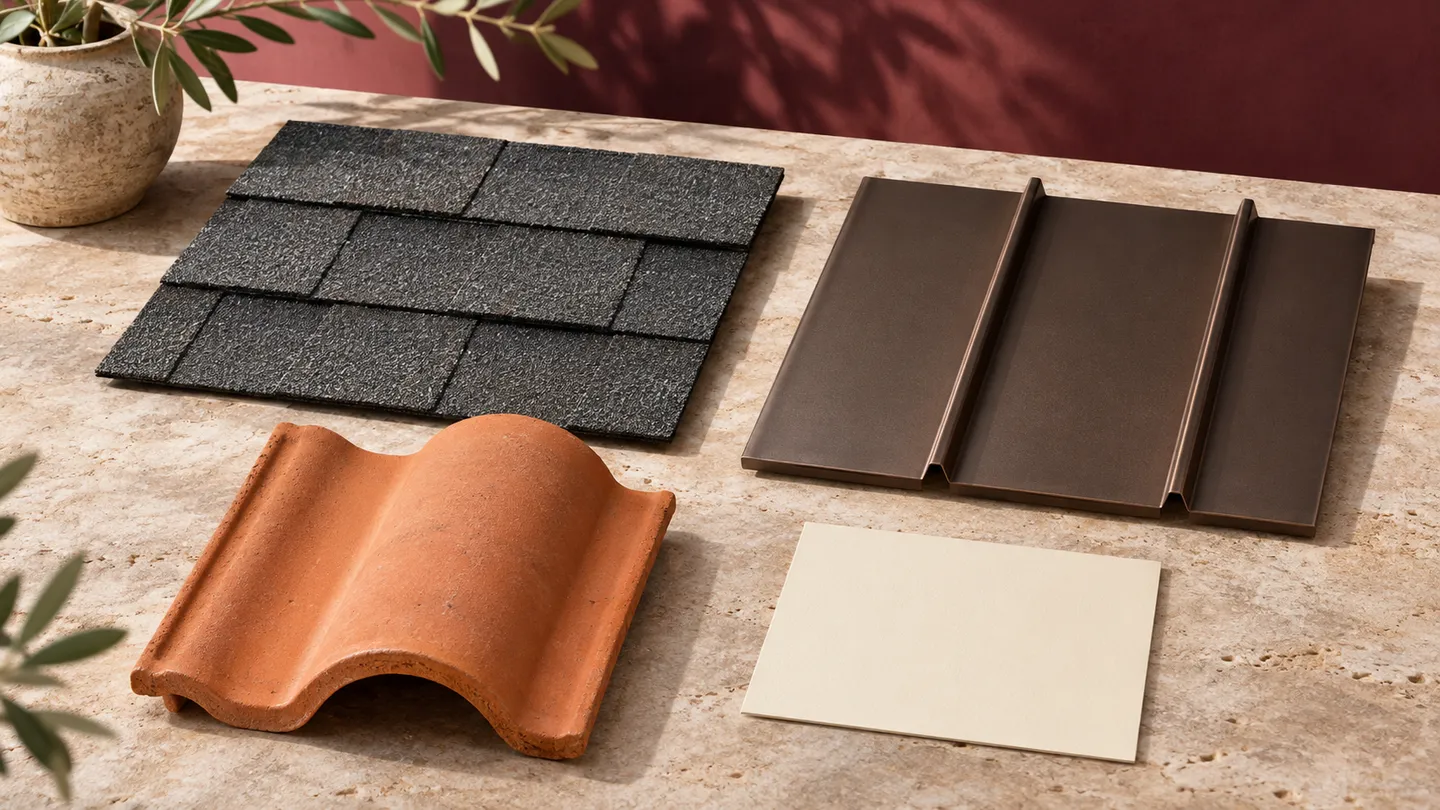
Strip or three-tab, dimensional or architectural, and luxury shingles are broad product categories. CertainTeed uses those categories to distinguish appearance and construction, but a category name does not establish the performance of every product within it.[2]
- Strengths: A wide range of appearances and a familiar residential format.
- Watch: Matching a weathered roof can be difficult. Installation, underlayment, flashing and ventilation requirements still need to be specified.
- Ask: Which product and system components are proposed, and what do the actual warranty documents cover?
Metal roofing
Standing-seam and exposed-fastener panels are different systems. McElroy’s comparison describes concealed fasteners in standing-seam systems and explains why thermal movement and attachment details matter. Do not assume every metal roof has the same seams, fasteners or maintenance needs.[3]
- Strengths: Several profiles and finishes can suit a home’s architecture.
- Watch: Penetrations, material compatibility, finish care and system-specific maintenance need attention. Snow can slide toward entrances or equipment.[4]
- Ask: How will the selected system handle movement, roof transitions and snow release?
Wood shingles and shakes
Shingles and shakes differ in appearance and manufacture, and the complete system needs product-specific assessment. Fire classification, local restrictions, slope, ventilation and maintenance are more useful selection criteria than a blanket claim that wood is either unsuitable or the best-looking option.
- Strengths: A distinctive texture where the system and property requirements allow it.
- Watch: Material care, fire requirements and replacement matching.
- Ask: Which tested assembly and maintenance instructions apply to the exact product?
Clay and concrete tile
Do not treat tile weight as a cosmetic detail. Eagle’s concrete-tile FAQ recommends an engineer’s determination of whether a structure can support the proposed weight or needs reinforcement. That concrete-specific guidance does not make every clay or slate roof the same assembly.[5]
- Strengths: Distinctive profiles and finishes.
- Watch: Structural suitability, underlayment, flashing, compatible repair tiles and safe access.
- Ask: What is the condition of the concealed layers, and can the required profile be matched later?
Natural slate
Natural slate requires an assessment of support, slope, attachment, flashing and repair expertise. A story about an old slate building does not establish the service life of a particular roof or prove that a contractor can install it.
- Strengths: A material-specific appearance that can be important to a building’s character.
- Watch: Weight, specialist detailing, fragile access and replacement-piece availability.
- Ask: Does the proposed system suit the structure, and who has relevant experience with that scope?
Synthetic and composite products
“Composite” covers several different products. Compare the manufacturer, composition, tested assembly, installation instructions and warranty rather than assigning the entire category one lifespan or price advantage.
- Strengths: Some products offer alternatives to a particular slate, shake or tile appearance.
- Watch: Products differ in weight, weathering, fire and impact classifications, attachment and warranty conditions.
- Ask: What specific evidence supports the proposed product’s suitability?
Vegetated roof systems
A living roof is a designed assembly, not soil and plants added to an ordinary roof. Structure, waterproofing, drainage, access and ongoing care must be considered together. It also is not the same category as every roof described as sustainable.
- Strengths: It may serve a building’s particular landscape or environmental goals when properly designed.
- Watch: Saturated loads, drainage, root protection, access and maintenance responsibilities.
- Ask: Is the building designed for that use, and who is responsible for the specialist systems?
Solar panels and solar roofing
Conventional roof-mounted panels generate electricity but do not replace the underlying roof covering. Building-integrated solar roofing is a different product choice. Roof condition, shading, structure, electrical work, equipment maintenance and the need to detach or reset equipment belong in the plan. DOE notes that panels and their mounting system need removal to carry out roof replacement.[6]
- Strengths: Electricity generation where the property and economics support it.
- Watch: The roof and solar equipment have separate responsibilities and warranties.
- Ask: Who handles roof penetrations, electrical work, removal/reinstallation and each applicable warranty?
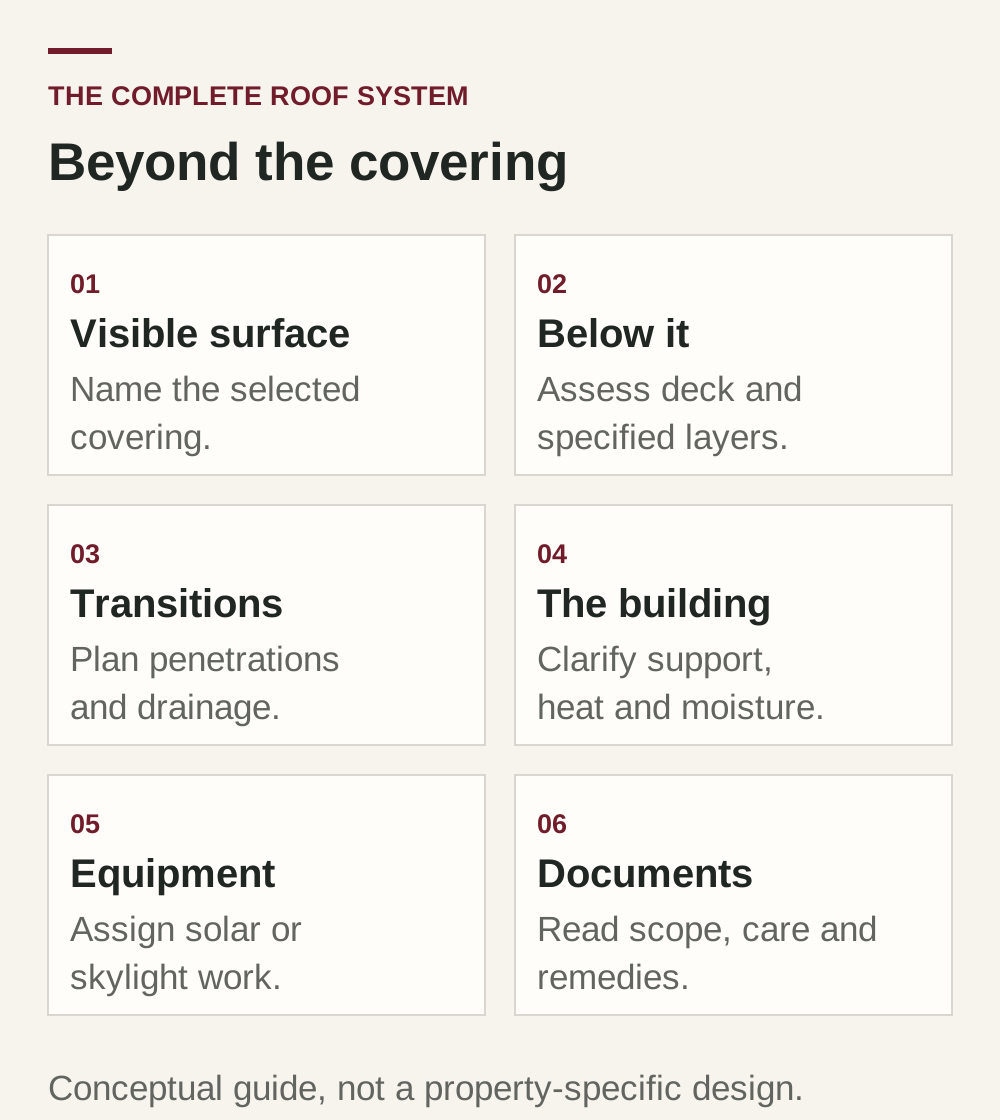
Compare the whole assembly
| Decision | What to compare |
|---|---|
| Fit | Slope, support, existing layers and the proposed use. |
| Water management | Decking, underlayment, flashing, penetrations and drainage. |
| Maintenance | Actual product instructions, access and replaceable components. |
| Energy | Product reflectance, building characteristics and annual heating/cooling trade-offs. |
| Cost | Measured roof area, removal, hidden repairs, system components and exclusions. |
| Coverage | Actual product defects, workmanship terms, eligibility and remedies. |
A reflective product may reduce cooling demand yet increase winter heating energy in a cold climate. EPA describes that trade-off; a metal label or light color alone is not a guaranteed energy saving.[7]
Use the material guides and the cost guide to compare a written proposal. Confirm which products and installation scopes are actually available for the property.
Questions homeowners ask
Which material lasts the longest?
There is no useful universal ranking for every assembly. Condition, design, application, exposure and maintenance affect service life, and the visible covering can outlast other components.[1]
Is metal automatically more energy efficient?
No. The specific reflective product, climate, insulation and the rest of the building influence annual energy use.[7]
Can any house support tile or slate?
Do not assume so. The proposed weight and structural suitability need assessment; concrete-tile guidance specifically calls for an engineer where needed.[5]
Does a product warranty cover installation mistakes?
Not automatically. Product defects, workmanship and enhanced system coverage are separate written terms.[8]
Related information
References
- NRCA: Roofing FAQs and proposal checklist
- CertainTeed: Types of asphalt roofing shingles
- McElroy Metal: Through-fastened and standing-seam systems
- Metal Roofing Alliance: Snow and ice
- Eagle Roofing: Concrete tile FAQs
- U.S. DOE: Should I replace my rooftop solar system?
- EPA: Using cool roofs to reduce heat islands
- CertainTeed: Understanding roof warranties
General homeowner information, not a property-specific assessment. Requirements and product instructions vary. Leave roof access, diagnosis and hazardous work to qualified professionals.